the ivory tower
a portable pick-up-and-play limited cube format
written as part of the 2025 advent calendar
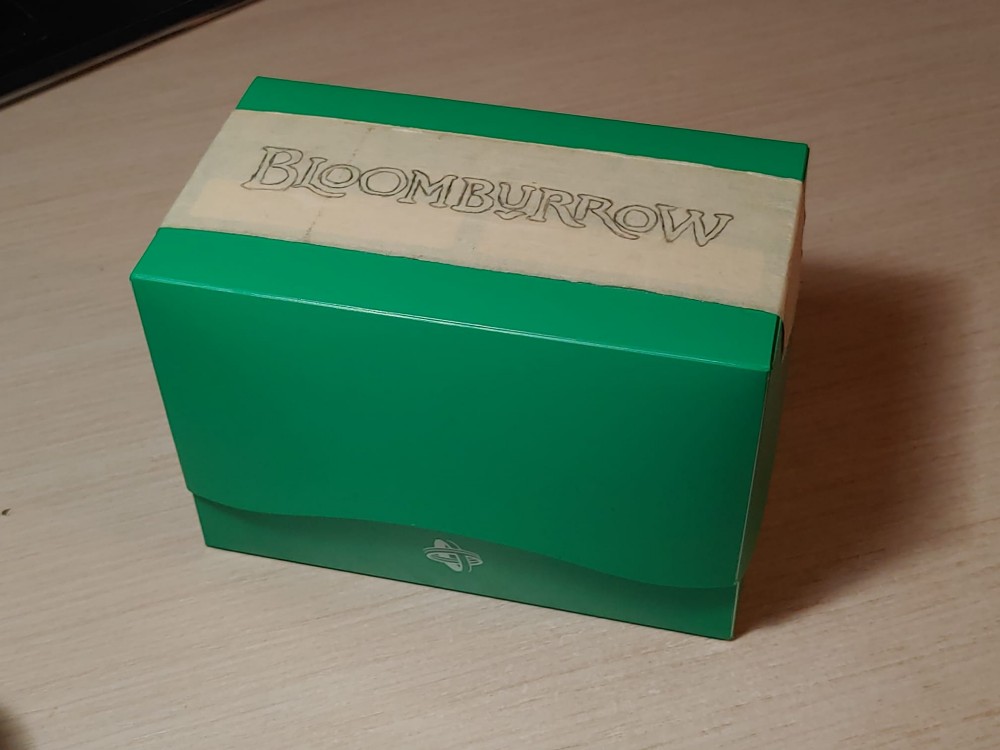
this primer is split into two parts:
the format
motivation and overview
the ivory tower was born out of a mix of the love for the game's sheer breadth of variety, from both the point of view of its quantity but also quality of design and modes of engagement, a love for physicality in games, and the desire for a simple, quick, easy to pick up but infinitely replayable and widely diverse way to play magic with my partner, especially when we're on the go which happens pretty often
the ivory tower is a self contained magic the gathering cube format. it's the perfect blend between a complex, large format like draft cube and simple and straight-forward format like the battlebox. as opposed to normal cubes, it doesn't require a lengthy drafting and deckbuilding phase, a phase which acts as a barrier of entry for many players anyway. the ivory tower is designed to be played in any scenario, whether on the go getting in a game or two in on a lenghty train ride, or at the kitchen table with drinks and snacks. despite that, it keeps all the best qualities of cubes, it's infinitely replayable, it's skill testing, and no two games ever feel the same. as opposed to battleboxes, the ivory tower doesn't feel like just playing five color top decked good stuff. you have the full ability to curate your plays and lend your strategy into draft archetypes or go into rogue "decks" with specific synergies you may run into. colors still mean something, and lands still mean something. despite that, it keeps all the best qualities of battlebox, it's a small, self-contained box that can be played anytime, anywhere, it's easy to understand and to pick up and playtime can last as little as 20-30 minutes, from opening the box to packing up
the ivory tower is my love letter to magic the gathering
how it came to be
fair warning, this section is a long ramble about the process of what i wanted from the format and how i developed it. if you'd rather jump to the actual specifics of the format, click here
i always wanted an easy way to pick up and play magic that doesn't rely on having decks already built. magic is a game of thousands of strategies and archetypes, limiting to just a few represented one per deck is not something i wanted to do. i also didn't want to be the one in charge of forever updating and balancing the collection of decks, it would simply not be feasible
cubes solve this by creating a wide draft environment offering way more methods of play. it's like having houndreds of decks in a neat package waiting to be discovered. cubing also involve two more giant pillars of interfacing with magic, drafting and collecting. cubes can be an expressive collection of cards, carefully curated to serve both functional and aesthetic purposes. drafting is like a different game in itself, it's an incredibly fun and engaging way to interface with magic. unfortunately cubes ask for big investments from both the cube designer and the cube player. cubes are bulky, can be expensive, and require a lot of space and time. you can never just play a cube, you have to organise a game night. it's just too much, i need something smaller and something quicker. something that doesn't ask for three to four hours and a handful of other players. there's also always the issue of balance, i don't want to take upon the burden responsibility of balancing between 10 different draft archetypes. moving on
i still love the idea of cubes though so i kept looking in the same vein. the collection aspect was too important to me, i love the idea of having a curated set of cards that showcase everything me and my girlfriend love about the game, displayed in beautiful artwork, different frames, variants, and so on. i'll keep calling it a cube for now, even if i'm not looking to build a cube
i've also landed on another idea that solves the issue of balance: it should be a set cube! by that i mean a cube that uses only cards from a specific set, usually trying to reproduce the draft archetypes of that set. i find the way sets are structured fascinating from a game design point of view. there's so much you can (rightfully) blame wotc for, they can sure make a game though. a set cube, in my eyes, has three major upsides: first, balance is pretty much solved for you. assuming a set is inherently balanced (as it should usually be), and maybe with a couple tweaks or so, balance is not an issue. second, it's cohesive. there's a big issue of dissonance in magic currently, but being able to maintain the cohesiveness of a set in a cube would be fantastic. third, they're collectible! you don't have to limit yourself to one set the way you would usually limit yourself to a cube or two, you could end up building set cubes for all the sets you want. they're an incredible way to showcase sets you love. this idea just sits right in my brain
so we're building a set cube. specifically, a bloomburrow (BLB) set cube. it's a set me and my girlfriend love a lot. it's also really easy, and more importantly cheap, to build set cubes. the driving force of a limited format are the common and uncommon cards, not rares or mythics. these are the nuts and bolts of every deck. cardmarket sells complete collections of cards of each rarity for every set. a complete collection of all the commons and uncommons in BLB cost about 30-40 euro, a little more if you include shipping. that's EXTREMELY affordable
alright, let's take a step back for now and define what else we want from this cube. the checkboxes to tick are:
- cube-like (curated collection of cards)
- easy to pick up/understand
- can be played in two players
- quick game sessions
- lots of replayability
- variety in ways to play
- portable
- doesn't abstract away aspects of magic
that last one is kind of odd isn't it? anyway we're talking about battleboxes now. as mentioned before, battleboxes tick some very important criteria i had: cube-like, easy to pick up, portable, quick, two players, replayable, varied... it sounds like the one, right? and for a while i thought it was the one. i even ended up building one! but, there's just something i could never get over. i hate how it abstracts away two major components of magic, lands and colors. in battlebox you're guaranteed a land drop every turn, ending up with a total of 5 basics and 5 duolands. if you don't need to care about them anymore it feels a bit... lackluster, to say the least. what's worse is that now that you're just given a land of every color for free, colors don't really matter all that much anymore. you just play cards off the top in more or less the order you draw them. it's still interesting to navigate the boardstates, but it just feels so... simplistic? unexciting. you never play a specific archetype or strategy, you play random cards, and after a couple games when the novelty wears off, it really feels like you're playing random cards
battleboxes are not what we're looking for it seems like. however, they still tick a lot of our requirements so i can't just ignore them fully. i had a brief stint of looking at jumpstart cubes, these being basically a curated collection of jumpstart-like packs. it's more in line with the many decks idea but they provide a lot of combinations. that being said, a tribal set like BLB is a really terrible fit for jumpstart. i also dislike not being able to (easily, cleanly) integrate two+ color cards in them. jumpstart cubes are not our choice
i looked at a lot of other formats and ideas. i'd frequently go on cubecobra and just browse, looking for inspiration. i rotated the battlebox idea in my mind for months probably. nothing i could find or i could come up with seemed to tick all these boxes. eventually i ran into the wizard's tower format. it looked interesting but it's still just a variant on the battlebox. i prefer it though, it introduces card selection by having the 7 cards you can choose from when you draw (which i will now refer to as the market), as well as lands mattering again. it's still easy to just get a land of each color and still play good stuff though
it's a good starting point though
how it works
structure
the ivory tower is a 200 card cube formed of 130 spells and 70 lands all shuffled together. a priority in its design was not just to make all 10 draft archetypes of the set playable, but to showcase everything unique the set has to offer. cycles are generally going to be your best friend when building a set ivory tower. i made a point of including cycles of cards that showcase more than just the cards required for each archetype. for representing the worldbuilding there's the uncommon calamities, doubling as effective bombs in their colors. the seasons and the talents show up both because they're very unique to BLB and, again, it was important to represent a little bit of everything from the full set. the duos serve as superb archetypal glue, filling two slots in the tower with one card. the gold mentors and the hybrid cards are fantastic signposts. i can't stress enough how great cycles feel to design this sort of cube with
i won't go over every single component of the BLB tower but there's another aspect of the spells. as i mentioned, the driving force of limited gameplay are commons and uncommons, and so the tower is primarily built using them. i had added some rares and mythics though. first off, the rare typal legends. they're a rare legendary creature for each tribe, serving as an amazing synergy piece for each tribe. the tower would be incomplete without them. the valley callers are very good archetypal glue and represent bloomburrow very well. i also couldn't ignore the seasons, the pawprint mechanic is unique to BLB and, once again, it's very important to me to represent everything the set has to offer
i'll link the cubecobra page at the end of this log. i have more (direct) details about setting up and playing and the card list is tagged very cleanly, showcasing these better
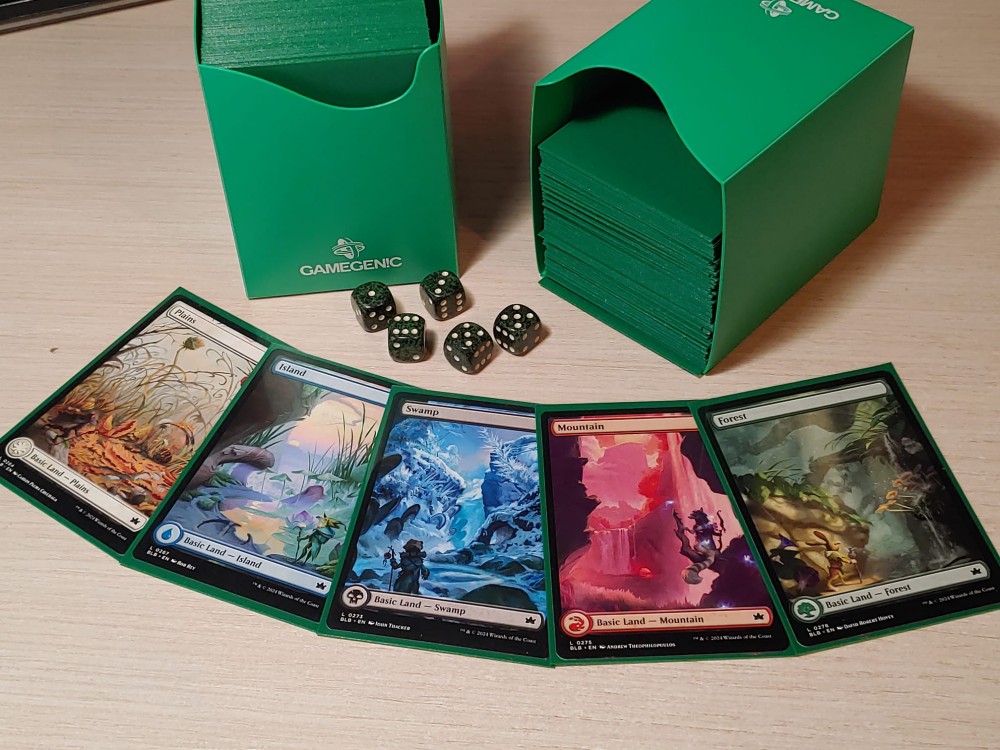
the lands are mostly basics. i included two of each village as well as two hidden grottos, two uncharted haven, and an exotic orchard. the orchard is from the bloomburrow commander set but i included it because i think it can be very fun and it received new unique art for bloomburrow. there's also the gainland cycle. BLB lacks a cycle of dual lands but these show up in the BLB starter decks and they're classic simple dual lands. i worried about them helping enable bats too freuqently but that wasn't an issue yet. if they do end up being an issue, the DMU duals can slot right in, the added land types shouldn't be an issue. i tried my best to pick arts that seem like they could be from the plane of bloomburrow for the duals. the rest are basics. i got one of each seasonal full art, then 2 and 3 of the other BLB basic arts for each land type. i'm very careful with printings and artworks as i wanted this cube to really represent and showcase bloomburrow
play
to play, shuffle the entire tower and deal 8 cards to both players. you're now "drafting" your opening hand. you pick 2 cards, exchange the packs, and pick another 2, then burn the rest. repeat once more to get 8 selected cards in hand. finally, pick one card from your hand to burn and you have your opening 7. i like this method much more than just drawing blindly from the top. it was a priority to move as much away as i can from the battlebox aspect of playing off the top. this way you have a lot of agency in your opening hand and already can pick a direction for your match
drawing for turn is as follows. you look at the top 8 cards of the tower. choose 1 to put in your hand and shuffle the rest. finally, put 3 at random back on the top of the tower and burn the other four. doing it like this lets cards propagate through multiple hands, simulating being in a pod of multiple players and having cards passed back to you. if you only were to choose one, if it happened you saw two cards good for you, sucks, one was getting burned. now it has a chance to actually come back and maybe you'll draw it next turn. there's more of a risk-reward play and i really enjoy how well it simulates a card returning to you in a draft
when drawing from an effect, look at the top 4 and pick one, burning the rest
and that's it! it ended up differing from a wizard's tower quite a lot, but i prefer it so much more. the name, ivory tower, came from wizard's tower actually. i didn't like that you have perfect information of your opponents hand from seeing what they draw from the market at all times. your hand should be private. so, ivory tower, a wizard's tower where your hand and information stays private and alone. it ticks all the boxes:
- cube-like (curated collection of cards) : yep, it's a cube
- easy to pick up/understand : once you get the hang of drawing for turn it's as easy as giving you a ready made deck. the cards are overall pretty simple and there aren't any added rules baggage
- can be played in two players : the 200 card size is perfect for two players
- quick game sessions : from opening up the tower to packing up it can take as little as 30 minutes
- lots of replayability : it's a set cube with all 10 draft archetypes represented and more, you're not getting bored of this
- variety in ways to play : see above
- portable : see the box, coming up
- doesn't abstract away aspects of magic : lands matter, color distinction matter, you can't really play random 5 color good stuff (more than you could in actual limited anyway), nothing is missing, it's a complete magic the gathering experience
bonus : pai gow magic
pai gow magic is a mini-format. it provides an alternative way to play that takes even less to play than a normal match. we've been playing it out of the tower to great enjoyment. in short, you draw until you have 15 spells, burning all lands. now out of the 15 cards you have you make 5 3-card decks. you have infinite mana and start at 5 life. that's it
it's a surprisingly fun and engaging way to play, adding a cool deckbuilding element. games play out quick it feels more like solving a puzzle than playing magic. speaking of deckbuilding
bonus : archetype precons
i still enjoy constructed magic. i've designed this tower so you can also build preconstructed decks, similar in power level to a pretty decent draft or a good sealed deck. in short, you pick a tribe and build a deck around it using the cycles present in the tower. the tribes you pick have to not share any colors though, so a cool way to do it is to shuffle one of each of the five basic lands together and each player draws two. if i drew a swamp and a forest, for example, i'm playing squirrels. here's how to build a deck:
- use all the 9 cards cards in your tribe tag (totalling 8 creatures and 1 spell)
- pick a valley caller, a calamity, a talent, and a season, two in each of your colors (totalling 10 creatures and 3 spells)
- pick five creatures from other tribes, two in one of your colors, three in another (tot. 15 and 3)
- pick four colored spells, two in each color (tot. 15 and 7, a perfect ratio for limited)
- now lands: pick the gainland in your color (tot. 1)
- four villages, two in each color (tot. 5)
- one uncharted haven and one hidden grotto (tot. 7)
- ten basics, five and five (tot. 17)
the numbers work out perfectly. it may take a minute to build but that's honestly part of the fun of it
the ivory tower has quickly become one of my favorite ways to play magic, if not my actual favorite way. there's just so much play you can get out of this one box. it's cheap, it's versatile, it's just a good ol' time. on a table in a park, waiting for a delayed train, at the kitchen table waiting for food delivery to show up, one slow afternoon, on a picnic blanket out...
the box
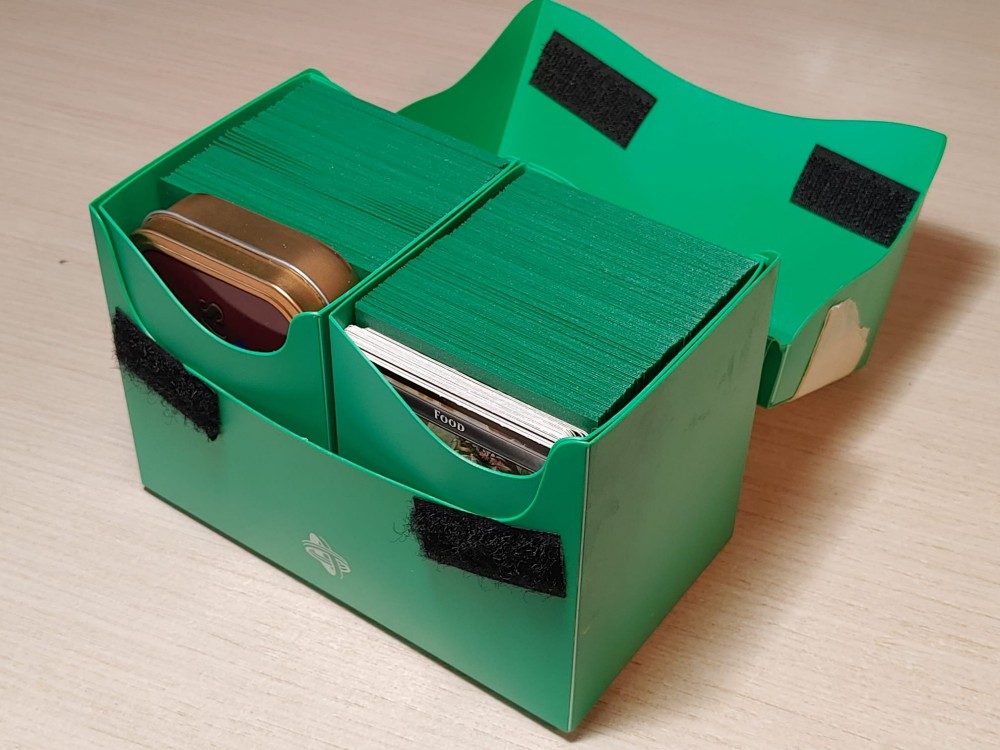
it opens! i'm very proud of this box. i used a gamegenic double deck holder 200+ XL box to which i fitted some velcro so the lid stays open. without the velcro the box easily hopens itself in a bag under the weight of the cards inside, but just those two little straps of velcro are enough to pass the throw-it-up-in-the-air-spinning-as-fast-as-you-can test without opening. i was very happy to find out that it holds more than 200 sleeved cards, meaning i got plenty of space for accessories
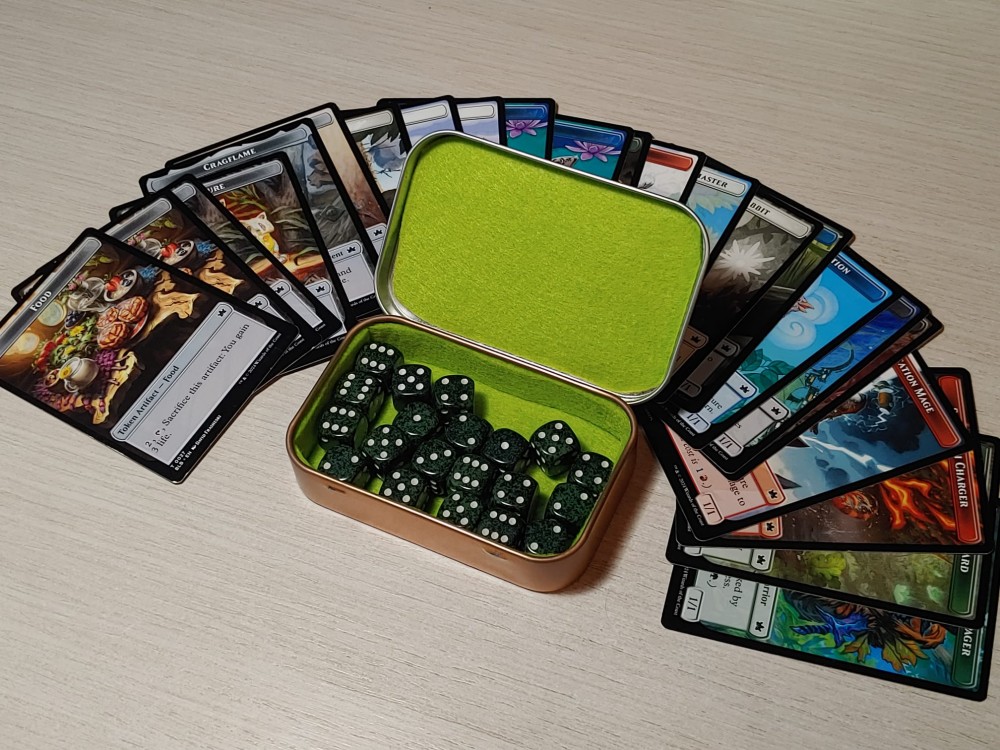
the accessories mostly consist of a barkley's mint tin with dice and tokens. the 20 dice in the tin are more than we'll ever need really but they look like the right amount visually. the tin itself is lined with a sheet of wool felt i got at an artshop which i cut up and taped using a foamy double sided tape. now the dice hitting around the walls of the tin are pleasantly muffled, the felt is doing a much better job of muffling them than i expected
as for the tokens, they're listed in the cubecobra page. it's at least one of everything you need, two if more than one card makes that specific token. so one of every offspring, one cragflame, and one sword, but two rabbits, two treasures, two foods, and two gifted fish. the logic is that, even if you make more of one kind of token, you can keep track of them with a dice. this way each player gets at least one. worst case just use the backside of another token to represent something but in about six months of playing this has only ever come up once
thank you, dear reader, for being with me as i yap about my box with cards for, uhm, 3100 words